Economics
EnergyPlus contains several input objects that allow economic analysis to be performed. When these input objects are included in the input file, new tabular output reports are automatically generated. The input objects used by EnergyPlus for cost estimating calculations are as follows:
- ComponentCost:LineItem - provides inputs related to determining the construction cost and can be associated with several different input objects and the cost estimate is based on factors such as cost per area or cost per unit of output capacity. It has not been applied to all types of input objects so for many scenarios; construction costing would need to be performed outside of EnergyPlus.
- ComponentCost:Adjustments - allows the specification of adjustments including miscellaneous costs per conditioned area, design and engineering fees, contractor fees, contingency, permitting, bonding, and insurance as well as commissioning and regional adjustment fees.
- ComponentCost:Reference - entry of reference building costs so that the current model can be compared to the reference building.
For many building projects, while energy estimates are important, the computation of estimated utility bills provides an understanding of how much money is going to be saved to help offset possibly higher initial costs of a high-performance building. Due to the many different utility companies and regulatory agencies, the approach used to compute monthly utility bills has become widely varied and, at times, quite complicated depending not only on energy and demand but the timing of each and the relationship between the two. Overall, the goals of the UtilityCost input objects of EnergyPlus are to make simple tariffs easy to model and complex tariffs possible to model. The 5ZoneEconomicsTariffAndLifeCycleCosts.idf example file provides several different example tariffs. The input objects used by EnergyPlus for the calculation of monthly and annual utility bills are as follows:
- UtilityCost:Tariff - sets the parameters for the overall tariff such as associated output meter, conversion factors, demand computation, monthly charges, and minimum charges, and schedule names for the time of use periods, seasons, billing cycle, and real-time pricing.
- UtilityCost:Qualify - provides a method to qualify if a tariff applies to the building being modeled since utilities provide limits usually based on peak demand or energy consumption for each tariff.
- UtilityCost:Charge:Simple - defines cost per unit value for a charge based on energy or demand or other charges for a specific season. The charges are arranged in a hierarchy shown in Figure X Hierarchy of Economic Charges.
- UtilityCost:Charge:Block - defines a more complicated but common type of charge for energy or demand where the costs are defined in the tariff with blocks of charges (i.e., the first 1000 kWh is one cost per kWh, the next 5000 kWh is a second cost, and remaining kWh is a third cost). Like UtilityCost:Charge:Simple, the charges use the same hierarchy.
- UtilityCost:Ratchet - some utilities charge not only for the current month's demand but also compensate for the highest demand in recent months, and this input object allows the specification of such a structure.
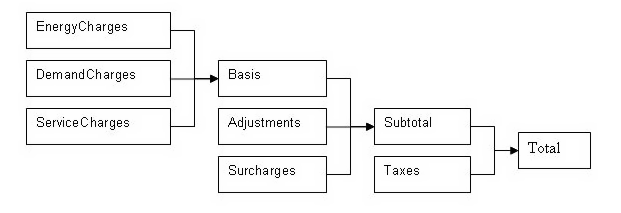
Hierarchy of Economic Charges
The following two input objects are uncommon to use:
- UtilityCost:Variable - allows the specific specification of a monthly variable to be used in the calculation of the tariff.
- UtilityCost:Computation - provides the step-by-step specification of the steps needed to compute the tariff. The output report tariff summary includes the default computation steps for the input objects specified.
Life-cycle costing allows the combination of initial and future costs (typically energy bills) to be understood using a single metric so that multiple building energy models can be compared even if they all have different initial and future costs. The input objects used for performing a life-cycle cost analysis are:
- LifeCycleCost:Parameters - describes the discount, tax, and inflation rates, the approach used for inflation and discounting, as well as the base date and length of the study period and other parameters related to life-cycle costing.
- LifeCycleCost:RecurringCosts - used to enter reoccurring costs other than costs related to energy and water usage since those are included automatically.
- LifeCycleCost:NonrecurringCost - used to enter costs that occur only once during the study period.
- LifeCycleCost:UsePriceEscalation - specifies the annual escalation of energy costs in future years and is generally based on government predictions. The increases in energy costs for future years are assuming they change differently than inflation. A file that is updated each year begins with the name LCCusePriceEscalationDataSet is included in the DataSets directory and is based on supplements to the NIST 135 handbook.
Two less commonly used input objects are
- LifeCycleCost:UseAdjustment - allows manual adjustment of energy or water costs in future years.
- CurrencyType - specifies the currency symbol of the monetary unit. If it is not included a dollar sign '$' is used in all reports.
All of these are described in the "Input/Output Reference" but note that this group is described in Chapter 3 "EnergyPlus Economics" while most of the other groups of input objects are described in Chapter 1. The OutputDetailsAndExamples documentation provides even more details on the tabular outputs created in the section labeled "eplustbl.\<ext>".