Advanced Construction, Surface, Zone Concepts
The group of input objects contains many special cases for more sophisticated modeling for constructions, surfaces, and zones. As part of this, one of the ways to model building foundations called Kiva is described. See the ZoneCoupledKivaBasement.idf and ZoneCoupledKivaSlab.idf example files for example of these input objects.
- Foundation:Kiva - describes the insulation depth and width for interior and exterior horizontal and vertical insulated foundations as well as the construction for the wall footing, see Figure X .
- Foundation:Kiva:Settings - sets the soil conditions and other parameters related to the Foundation:Kiva input object.
- SurfaceProperty:ExposedFoundationPerimeter - used to set the portion of the foundation that is along the exterior perimeter of the building that undergoes heat transfer with the environment. Edges of underground surfaces that are fully under the building and not along the perimeter are not expected to have any heat transfer with the environment.
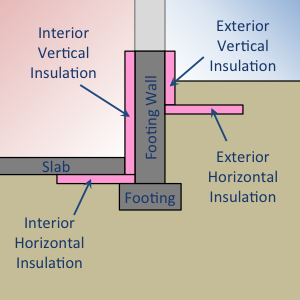
Structural and insulation components of Foundation:Kiva input objects
Input objects of interest in this group not related to Kiva include
- SurfaceControl:MovableInsulation - allows the modeling of insulation panels that are removable for walls, floors, and roofs but not windows. See MovableExtInsulationSimple.idf and MovableIntInsulationLightsLowE.idf example files.
- SurfaceProperty:Underwater - allows the outside of the building to be modeled as underwater and even as moving through the water allowing EnergyPlus to model vessels. See the VaryingLocationAndOrientation.idf example file.
- SurfaceProperty:ExteriorNaturalVentedCavity - provides a method to include the modeling of baffles in the multi-skin exteriors. See the HP_wICSSolarCollector.idf example file.
Other input objects in this group set the heat transfer algorithms for specific surfaces to override the building level heat transfer algorithm, when other models are used to describe the variation in temperature on the outside of a surface, override the algorithm used for modeling convection heat transfer between the air inside or outside of a zone and the surface, vapor transfer coefficients when using algorithms that include moisture modeling of surfaces, override the algorithm that distributes the solar radiation on interior surfaces, overrides the solar energy absorbed by different layers for complex windows, a way to override the longwave radiation with other surfaces in the zone, allows overriding the external environment for a surface or a zone including solar shading or airspeed or temperature or humidity, overrides the source term for the heat balance, or overrides the view factors for a zone. The input objects described in this section are further explained in the InputOutputReference under the heading "Group-Advanced Surface Concepts."